

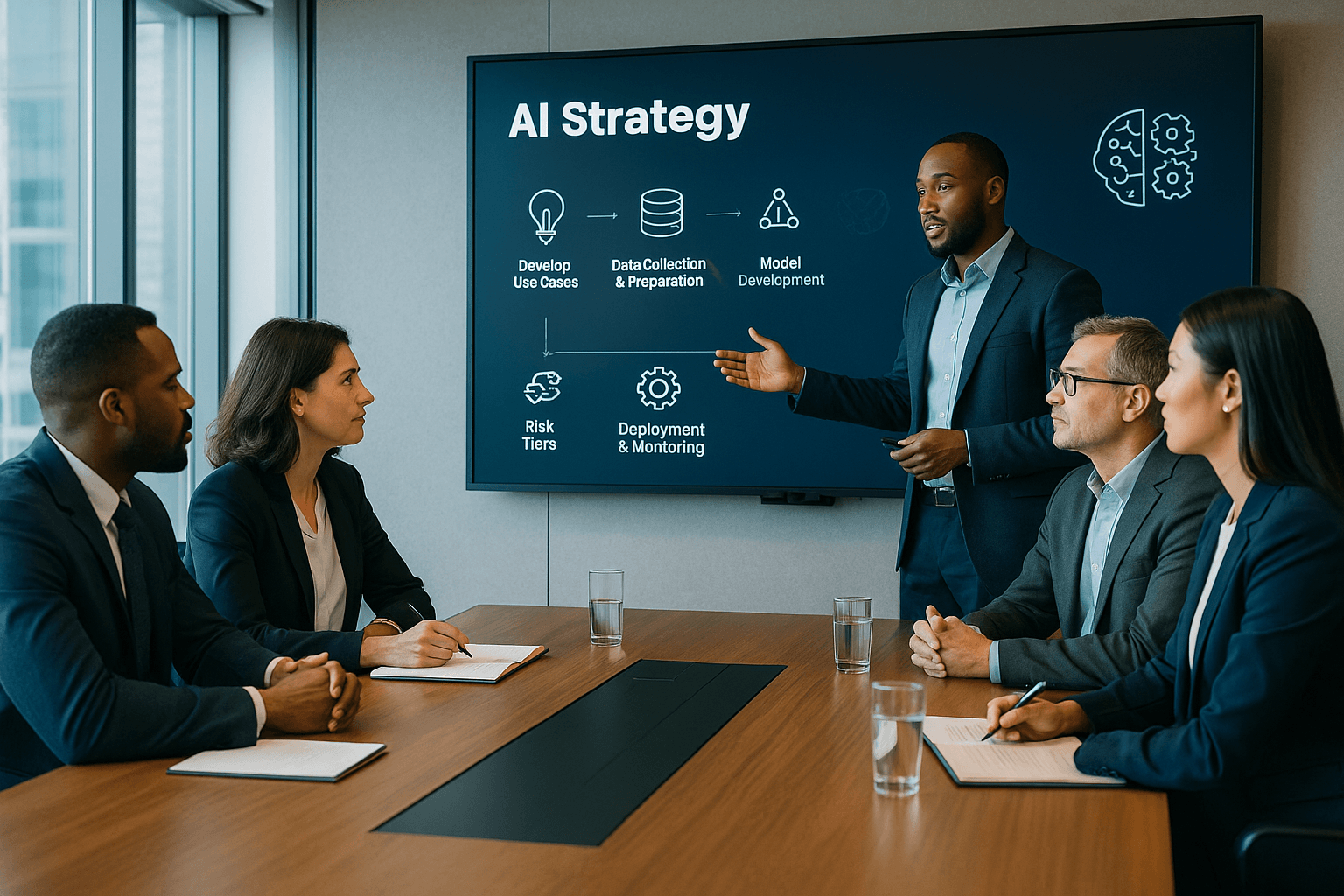
Leadership in an AI world has shifted from experimentation to execution. For IT executives, the leadership challenge is no longer “if” but “how fast and how safely.” This guide from IT Leadership Hub distills what high-performing CIOs and CTOs are doing right now to turn GenAI, automation, and data strategy into durable advantage—without inviting avoidable risk.
TL;DR
- Treat AI as a business operating model change, not a tool rollout.
- Stand up pragmatic AI governance that balances innovation, ethics, and compliance.
- Win hearts and habits: upskill, reskill, and make “human-in-the-loop” the default.
- Measure value with ruthless clarity: ROI, time-to-value, adoption, and risk posture.
Why now: The leadership moment
AI compresses the distance between idea and impact. GenAI accelerates content, code, and knowledge retrieval; automation removes toil; MLOps and model risk management make outcomes repeatable. As competitors slash cycle time, Leadership in an AI world is about orchestrating strategy, governance, and culture so your enterprise learns faster than the market.
- Strategic shifts: From projects to products; from IT ownership to federated delivery under guardrails.
- Risk shifts: From app vulnerabilities to data, privacy, and model risks; from perimeter security to continuous assurance.
- Talent shifts: From static roles to fluid skills; from “shadow AI” to governed, human-in-the-loop practices.
Leaders who adapt their operating model—not just their tech stack—set the pace.
The operating model: Who decides, and how
Define clear swim lanes so decisions travel at the speed of opportunity:
- Executive AI Council: Sets AI strategy, risk appetite, and funding guardrails.
- AI Product Owners (in business lines): Own outcomes and adoption KPIs.
- Platform Team (IT/Engineering): Provides secured tooling, MLOps, and data access patterns.
- Risk Triad (Security, Privacy, Legal): Applies model risk management and compliance review.
- Change & Enablement: Drives communications, training, and workforce upskilling/reskilling.
Governance & ethics: Guardrails that enable speed
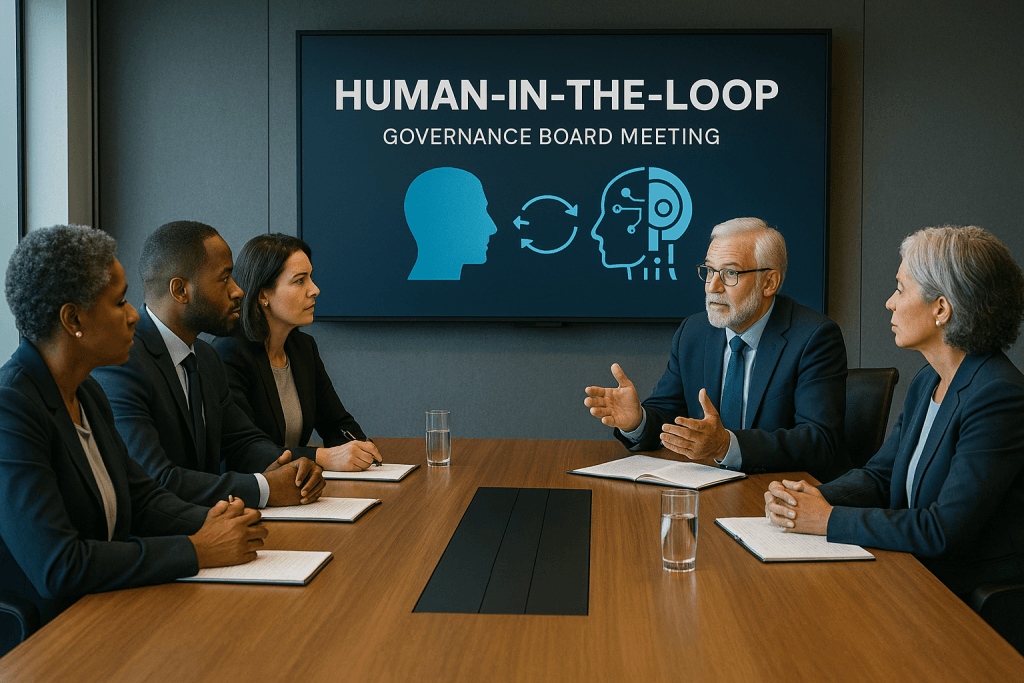
Practical AI governance is an accelerator when it’s risk-based and right-sized for leadership in an AI world:
- Policy: Define acceptable use, data classification, and human-in-the-loop obligations.
- Model Risk Management: Inventory models, rate impact, require validation and monitoring.
- Responsible AI: Embed fairness, transparency, and explainability where material.
- Controls: Prompt governance, data leakage prevention, and third-party model due diligence.
External references worth integrating:
- NIST’s AI Risk Management Framework NIST AI RMF
- Gartner’s analysis on enterprise AI adoption Gartner Research
- Leadership perspectives on responsible AI from Harvard Business Review
People & culture: Trust is your throughput
Tech alone doesn’t transform—people do. Make responsible leadership in an AI world the easy path:
- Upskilling/Reskilling: Role-based learning for product owners, engineers, risk, and frontline users.
- Change management: Clear benefits, new ways of working, and manager toolkits.
- Inclusion and ethics: Diverse review boards to surface blind spots and ensure equitable impact.
- Incentives: Tie performance goals to adoption, outcomes, and responsible behaviors.
Value & metrics: Prove it early and often
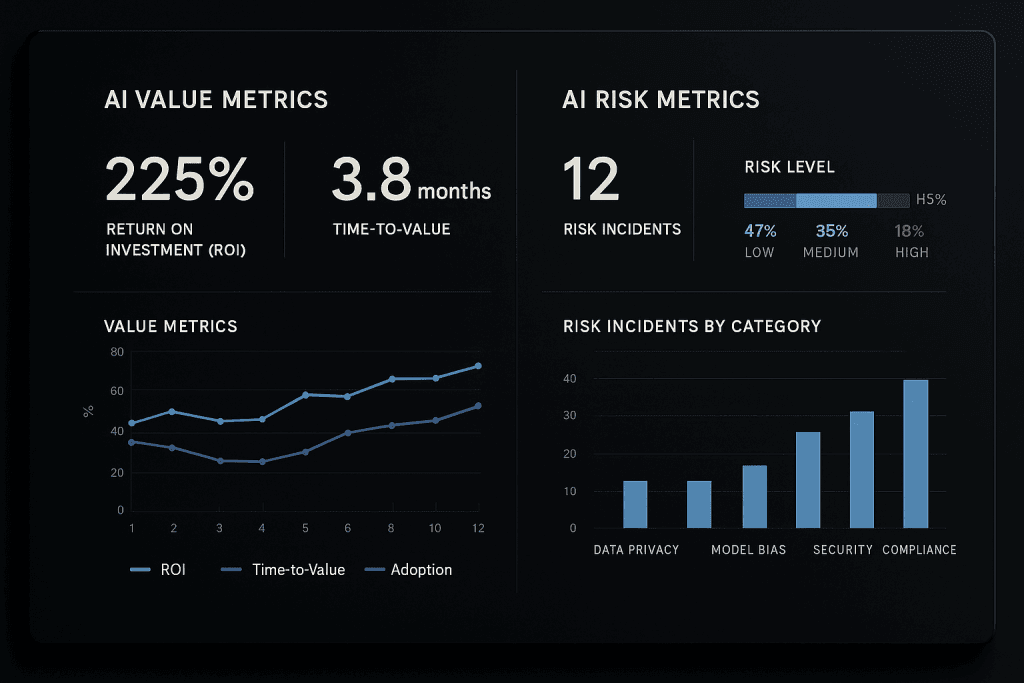
Anchor your roadmap to business outcomes and measure relentlessly with leadership in an AI world:
- Financial: ROI, margin impact, cost-to-serve, revenue uplift.
- Speed: Time-to-value, lead time for changes, cycle times.
- Adoption: % of workflows augmented, active users, NPS/satisfaction.
- Risk posture: Model incidents, privacy events, policy exceptions, audit findings.
Risk & resilience: Design for “safe default”
AI expands your attack and compliance surface. Blend cybersecurity, privacy engineering, and MLOps:
- Data privacy: Minimize sensitive data in prompts; tokenize or redact where feasible.
- Security: Control plane hardening, identity and access, and supply chain checks for models.
- Observability: Drift, bias, and performance monitoring; rollback plans; human-in-the-loop confirmations for high-impact actions.
- Continuity: Scenario playbooks for outages, provider changes, and regulatory shifts.
Executive framework: The 5×5 AI Leadership Playbook
- Clarify the business bet
- Choose 3–5 high-value use cases tied to P&L.
- Define owners, baseline, target ROI, time-to-value.
- Stand up the platform
- Secure foundation (identity, secrets, data access), MLOps, and sandbox-to-prod pathways.
- Curate approved models and patterns.
- Govern with outcomes
- Risk-tier models; require validation for high/critical tiers.
- Enforce human-in-the-loop where harm is plausible.
- Mobilize people and change
- Role-based enablement; playbooks for managers.
- Incent adoption and safe experimentation.
- Measure, learn, scale
- Instrument KPIs; publish scorecards.
- Reinvest in winners; retire low-yield pilots.
Case-style examples
- Global Bank (GenAI in operations): Starting with KYC summarization and policy Q&A, the bank used human-in-the-loop review for all regulatory outputs. Time-to-value: 8 weeks, with 30% reduction in handling time and zero compliance findings after go-live demonstrating leadership in an AI world.
- Industrial Manufacturer (Predictive service): MLOps standardized model releases across regions. Outcomes included 12% fewer unplanned outages and a repeatable pattern for new assets in 6 weeks showing excellent leadership in an AI world.
- Healthcare Network (Clinical documentation): Prompt governance and privacy-safe data routing enabled note drafting. Human review remained mandatory. Clinician satisfaction rose while documentation time fell by 25%. A direct result of leadership in an AI world.
AI readiness checklist (quick audit)
| Item | What “Good” Looks Like | Owner | Status |
|---|---|---|---|
| Business use cases | 3–5 value-backed, sequenced by ROI & risk | Product Owners | ☐ |
| Platform & MLOps | Secure, monitored, with model catalog | Platform Lead | ☐ |
| AI governance | Policy + risk tiers + validation process | Risk Triad | ☐ |
| Data strategy | Classified data, access controls, lineage | Data Lead | ☐ |
| Change & training | Role-based enablement and comms plan | Enablement | ☐ |
FAQ
How should leaders govern AI responsibly?
Adopt a risk-based approach using NIST’s AI RMF as a foundation and tailor controls by impact tier. Keep humans-in-the-loop for high-consequence decisions and monitor models for drift, bias, and security.
What belongs in an enterprise AI policy?
Scope (what’s in/out), data classification, prompt usage rules, approved tools/models, model lifecycle controls, incident response, and audit requirements.
Where do we start if we’re early?
Pick 1–2 high-ROI, low-to-moderate risk use cases, establish a minimal platform and governance, measure outcomes weekly, and expand only after the first wins.
How do we ensure ROI and faster time-to-value?
Attach each use case to a P&L metric, set a 90-day value hypothesis, and publish adoption/impact scorecards. Stop or pivot quickly if signals are weak.
What about compliance and cybersecurity?
Bake privacy and security into the platform: least-privilege access, data minimization, and validated model releases. Log everything and test fail-safes.
Key Takeaways
- Leadership in an AI world means redesigning how decisions, risks, and skills flow across the enterprise.
- Governance should speed innovation, not stifle it—right-size controls to impact.
- Value is proven through adoption and outcomes, not pilots.
- People-first change turns responsible AI into daily habits.
Questions about leadership in an AI world? Contact Us!

Chris "The Beast" Hall – Director of Technology | Leadership Scholar | Retired Professional Fighter | Author
Chris "The Beast" Hall is a seasoned technology executive, accomplished author, and former professional fighter whose career reflects a rare blend of intellectual rigor, leadership, and physical discipline. In 1995, he competed for the heavyweight championship of the world, capping a distinguished fighting career that led to his induction into the Martial Art Hall of Fame in 2009.
Christopher brings the same focus and tenacity to the world of technology. As Director of Technology, he leads a team of experienced technical professionals delivering high-performance, high-visibility projects. His deep expertise in database systems and infrastructure has earned him multiple industry certifications, including CLSSBB, ITIL v3, MCDBA, MCSD, and MCITP. He is also a published author on SQL Server performance and monitoring, with his book Database Environments in Crisis serving as a resource for IT professionals navigating critical system challenges.
His academic background underscores his commitment to leadership and lifelong learning. Christopher holds a bachelor’s degree in Leadership from Northern Kentucky University, a master’s degree in Leadership from Western Kentucky University, and is currently pursuing a doctorate in Leadership from the University of Kentucky.
Outside of his professional and academic pursuits, Christopher is an active competitive powerlifter and holds three state records. His diverse experiences make him a powerful advocate for resilience, performance, and results-driven leadership in every field he enters.



0 Comments