

You just got promoted. Week two, a department head pings you: “We already signed with a new SaaS vendor—can you approve the SSO and data access today?” You glance at the contract. There’s no breach notice timeline, no mention of subcontractors, and the vendor wants to store customer data “as long as needed.”
That’s vendor risk management in real life: not theory, not paperwork—your organization’s data, uptime, and reputation depending on a vendor you didn’t pick, for a contract you didn’t negotiate, with consequences your team will own.
Table of contents
- What vendor risk management is (and why IT owns it)
- The hidden risks most IT leaders miss
- Vendor tiering model (with example criteria)
- 30/60/90-day vendor risk management program
- Vendor due diligence checklist (security, privacy, operational)
- Contract clauses IT leaders should insist on
- Continuous monitoring and reassessment cadence
- Vendor offboarding: avoid “data ghosts”
- Key takeaways
- FAQs
- CTA
What vendor risk management is (and why IT owns it)
Vendor risk management is the structured way you identify, assess, reduce, and monitor risks introduced by third parties—especially vendors who touch your systems, data, or critical operations.
Even if Procurement signs the contract, IT leaders still “own” the outcomes because:
- Vendors connect to your identity systems, endpoints, networks, and data stores.
- Vendors become part of your supply chain risk footprint (software, hosting, support, subcontractors).
- When incidents happen, stakeholders look to IT for containment, recovery, and communication.
A practical way to explain it to your leadership team:
Procurement manages the purchase. IT manages the exposure.
Frameworks like NIST’s supply chain guidance emphasize that cybersecurity risk travels through suppliers and services—and needs to be managed as part of enterprise risk.
The hidden risks most IT leaders miss
Here are the “usual suspects” in third-party risk—the stuff that doesn’t show up in the demo:
1) Security risk
- Weak access control (shared accounts, no MFA, poor admin segregation)
- Limited logging/monitoring (can’t prove what happened)
- Slow patching and weak vulnerability management
- Poor incident response readiness
2) Privacy risk
- Over-collection of personal data “just in case”
- Unclear data retention and deletion practices
- Data used for analytics/training without clear boundaries
- Missing data processing agreement (DPA) terms when personal data is processed (common under GDPR-style expectations)
3) Resiliency and operational risk
- Single-region hosting
- No tested backups
- Undefined RTO/RPO (how fast they recover; how much data they can lose)
- No plan for vendor outages or degraded modes
4) Financial and business viability risk
- Vendor runway is short; layoffs gut support
- Acquisition changes product direction and security posture
- Pricing changes force rushed migrations
5) Legal / contract risk
- Vague breach language (“promptly”)
- No right to audit or evidence
- No subcontractor controls (their vendors become your risk)
6) Concentration risk
- Too many critical workflows rely on one vendor (or one cloud region)
- A “shared dependency” (e.g., a common identity provider or CDP) becomes a single point of failure
7) Fourth parties: subcontractors and subprocessors
Your vendor uses cloud hosting, support firms, analytics tools, and subcontractors—subcontractors/fourth parties can become the real risk layer if they’re unmanaged. NIST supply chain guidance explicitly highlights the importance of managing exposure across the supply chain.
Real-world mini-scenarios
Scenario 1: The “SOC 2” that doesn’t cover what you need
A vendor sends a SOC 2 report—great. But it’s Type I (point-in-time) and excludes the product module you’re buying. Your move: request the report scope, carve-outs, and complementary user entity controls (CUECs), then require an action plan for exceptions.
Scenario 2: The subcontractor surprise
A vendor’s support subcontractor gets breached, and your customer data is in their ticketing system. Your move: require subcontractor disclosure, flow-down security obligations, and incident notification that includes subcontractor events.
Scenario 3: The “data ghost” after offboarding
You terminate a tool, but months later you discover API keys still active and data retained in backups “indefinitely.” Your move: offboarding checklist + written destruction attestation + disable integrations on your side.
Vendor tiering model with example criteria
Tiering lets you spend time where it matters. Use four tiers:
Critical
Criteria examples:
- Processes regulated data (PHI/PCI), sensitive customer data, or core IP
- Has privileged access (admin, direct DB access, broad API scopes)
- Outage stops revenue, safety, or core operations
- Integrates with identity/SSO and multiple systems
High
- Access to sensitive internal data (but not crown jewels)
- Operationally important, but workaround exists
- Limited privileged access
Medium
- Standard business data, limited integration
- Minimal access scopes; outage is painful but tolerable
Low
- No sensitive data, no integrations, low operational impact (e.g., a standalone productivity add-on)
Tip for new leaders: decide tier using impact + access + substitutability:
- Impact if they fail (business criticality)
- Access they have (systems/data)
- Substitutability (how quickly you can replace them)
30/60/90-day vendor risk management program
This is a “start where you are” plan—fast, realistic, and defensible.
New IT Leader VRM Quick Start Checklist (30/60/90)
First 30 days: stabilize and gain visibility
- Inventory vendors: systems, integrations, data types, business owner, renewal date
- Create a simple risk register entry for top vendors (tier + top risks + next action)
- Define tiering rules and assign tiers to your top 20 vendors
- Freeze “net-new critical vendors” unless they go through due diligence
- Establish minimum security requirements: MFA, encryption, logging, incident notification timeline
Days 31–60: standardize due diligence + contracts
- Implement a due diligence workflow (intake form → tier → questionnaire → evidence → decision)
- Choose a questionnaire baseline (lightweight or SIG questionnaire for higher tiers)
- Require evidence for Critical/High (SOC 2, ISO 27001, pen test summary, IR plan)
- Create contract addendum templates: security, privacy (DPA), incident notification, subcontractors, SLAs
- Start remediation tracking for gaps (owner + date + mitigation)
Days 61–90: operationalize monitoring + offboarding
- Set reassessment cadence by tier (quarterly/semiannual/annual)
- Stand up continuous monitoring for critical vendors (alerts + reviews)
- Run a tabletop: “vendor breach” and “vendor outage” with business stakeholders
- Build the vendor offboarding process (data return/destruction, access removal, key rotation)
- Publish a one-page VRM policy: “how we buy, assess, monitor, and exit vendors”
Vendor due diligence checklist (security, privacy, operational)
You don’t need perfect data. You need enough confidence for the risk level.
Vendor Due Diligence Checklist
A) Security controls (minimum baseline)
- Encryption in transit (TLS 1.2+ or better) and encryption at rest
- Strong access control (RBAC, least privilege, MFA for admins)
- SSO/SAML/OIDC support (if applicable) with granular role mapping
- Centralized logging (admin actions, auth events, data access) + log retention
- Vulnerability management: scanning frequency, patch SLAs, remediation tracking
- Secure SDLC and change management (especially for SaaS)
- Incident response plan (roles, escalation, comms, post-incident review)
- Backup and recovery approach + tested restore results
B) Privacy and data handling
- Data types processed (PII, PHI, PCI, confidential business data)
- Data minimization: only collect what’s needed
- Data retention policy + deletion timelines (including backups where feasible)
- Cross-border transfer approach (where data is stored/processed)
- DPA available (if personal data is processed); subprocessors disclosed
- If healthcare PHI is involved: confirm need for a business associate agreement (BAA) and use HHS sample provisions as a reference point.
C) Operational resilience
- Documented RTO/RPO targets (per service tier)
- Uptime history and status page transparency
- BCP/DR plan + last test date and results summary
- Support model: hours, escalation, response times
SOC 2 / ISO evidence guidance (plain English)
- SOC 2: a report on controls related to trust criteria like security/availability. Prefer Type II (controls tested over time), and verify scope and exceptions.
- ISO/IEC 27001: a certification focused on an information security management system (ISMS). Ask for the certificate scope and whether key services are included.
Quick rule: SOC 2 / ISO helps—but doesn’t replace asking: “Does this cover the product, region, and service we’re actually buying?”
Contract clauses IT leaders should insist on
Contracts are where “trust” becomes enforceable. Here are the clauses that matter most, with plain-language summaries and example clause language.
Contract & Security Addendum Checklist
- Breach/incident notification timeline + content requirements
- Right to audit / right to evidence (SOC 2, pen test summary, control attestations)
- Subcontractor / subprocessor controls + approval/notice
- SLAs (uptime) + support response times + service credits
- RTO/RPO commitments for critical services
- Data ownership + return/destruction on termination
- Security baseline requirements (MFA, encryption, logging, vuln mgmt)
- Cooperation clause (support investigations, eDiscovery, regulator inquiries)
1) Breach notification timelines
Plain English: “If something happens, tell us fast—so we can protect customers.”
Example clause language:
“Vendor will notify Customer within 24 hours of any confirmed Security Incident affecting Customer Data, and will provide updates at least every 24 hours until containment. Notification will include known scope, affected systems/data types, indicators of compromise (if available), and mitigation steps.”
2) Right to audit / right to evidence
Plain English: “We don’t need to camp in your office. But we need proof.”
Example clause language:
“Upon request, Vendor will provide reasonable security evidence, including current SOC 2 Type II report and/or ISO 27001 certificate scope, and remediation status for material findings. Customer may conduct a security review no more than once annually, or following a material incident.”
3) Subcontractor controls (fourth parties)
Plain English: “Your vendors can’t become our blind spot.”
Example clause language:
“Vendor will maintain a list of all subprocessors with access to Customer Data and provide 30 days’ notice before adding a new subprocessor for Critical services. Vendor will flow down security and confidentiality obligations at least as protective as this Agreement.”
4) SLAs / uptime + RTO/RPO
Plain English: “Define reliability expectations and recovery commitments.”
Example clause language:
“Vendor will meet 99.9% monthly uptime (excluding scheduled maintenance). For Critical services, Vendor commits to RTO of 8 hours and RPO of 1 hour, tested at least annually, with results available upon request.”
5) Data ownership + return/destruction
Plain English: “Our data is ours. When we leave, we take it—and you delete it.”
Example clause language:
“Customer retains all right, title, and interest in Customer Data. Upon termination, Vendor will return Customer Data in a commonly used format within 30 days, and will delete Customer Data within 60 days, providing written attestation of deletion (excluding archival backups retained solely for disaster recovery, subject to documented retention limits and access controls).”
Continuous monitoring and reassessment cadence
Vendor risk isn’t “one-and-done.” Your vendor’s environment changes—teams, tools, subcontractors, even business models.
Use a simple cadence:
- Critical: quarterly check-in + annual full reassessment
- High: semiannual check-in + annual reassessment
- Medium: annual reassessment
- Low: reassess at renewal or when scope changes
What “continuous monitoring” can mean (without buying a giant platform):
- Track vendor status pages and outage history
- Monitor security advisories and breach disclosures
- Require updated SOC 2/ISO evidence on schedule
- Review access logs and integration scopes (your side)
- Re-tier when scope changes (new data types, new integrations, new regions)
CISA’s supply chain resources emphasize structured ways to assess supplier posture and standardize questions—helpful when you’re scaling beyond “spreadsheet management.”
Vendor offboarding: avoid “data ghosts”
Offboarding is where good programs prove they’re real. The goal: no lingering access, no retained data surprises, no operational cliff.
What “clean exit” looks like
- Technical: revoke tokens, disable SSO app, rotate API keys, remove firewall allowlists
- Data: export what you need, confirm deletion, verify backup/retention commitments
- Operational: transition plan, owner sign-off, rollback plan if cutover fails
- Legal: termination notice, final invoices, written data destruction attestation
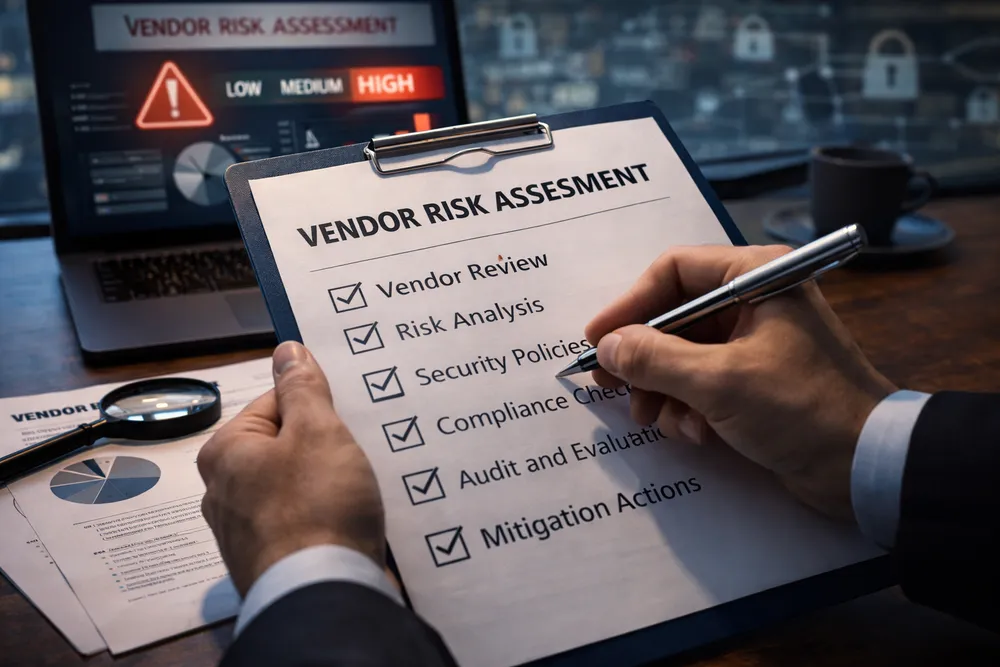
Vendor offboarding checklist (core steps)
- Confirm termination date + access cutoff plan
- Export data + validate data integrity
- Disable integrations (SSO, SCIM, APIs, webhooks)
- Revoke tokens/keys and rotate secrets used with vendor
- Confirm subcontractors no longer have access
- Obtain data deletion/destruction attestation
- Update asset inventory + risk register (status: retired)
Key Takeaways
- Vendor risk management is IT leadership work because vendors touch your data, uptime, and security—even if Procurement signs.
- Tier vendors by impact + access + substitutability, then spend effort where it matters most.
- Due diligence is about evidence + scope, not just collecting PDFs (SOC 2/ISO help, but verify what they cover).
- Contracts are your leverage: insist on notification timelines, subcontractor controls, right to evidence, and clear data return/deletion.
- Monitoring and offboarding prevent “set-and-forget” risk and eliminate “data ghosts.”
FAQs
1) What is vendor risk management?
Vendor risk management is the process of identifying, assessing, reducing, and monitoring risks introduced by third-party vendors that access your systems, data, or critical operations.
2) How is vendor risk management different from third-party risk?
“Third-party risk” is the broader category (vendors, partners, contractors). Vendor risk management focuses specifically on vendors—especially technology and service providers.
3) Do I really need SOC 2 or ISO 27001 for every vendor?
No. Use tiering. For Critical/High vendors, SOC 2 Type II or ISO 27001 evidence is often appropriate—but always verify scope and exceptions.
4) What is the SIG questionnaire, and when should I use it?
The SIG questionnaire is a standardized vendor assessment question set used to evaluate third-party risk across domains. It’s most useful for higher-tier vendors when you need consistent, comparable answers.
5) What’s the minimum breach notification timeline I should require?
Many orgs target 24–72 hours depending on risk and regulation. For Critical vendors handling sensitive data, 24 hours is a common leadership-standard starting point (and forces faster escalation).
6) What is a DPA, and when is it required?
A data processing agreement (DPA) is used when a vendor processes personal data on your behalf; it clarifies responsibilities, subprocessors, security, and deletion/return expectations.
7) When do I need a BAA?
If you’re a covered entity or business associate handling PHI under HIPAA and a vendor will access/process PHI, you typically need a business associate agreement (BAA). HHS provides guidance and sample provisions.
CTA
If you’re a new IT leader, vendor risk management is one of the fastest ways to build trust: you’re protecting the business before the next incident forces the issue.
To keep building your “leader toolkit,” explore these related ITLeadershipHub.com resources:
- New IT Leader? Your First Job Isn’t Innovation—it’s Damage Control
- Metrics That Matter for IT Leadership
- Cybersecurity as a Leadership Issue (Not Just a Technical One)
- From Experimentation to Excellence: Building a Robust AI Strategy and AI Governance Framework in 2026
- Year-End IT Leadership Priorities
- Best Practices in IT Leadership
- Leadership Challenges in Information Technology

Chris "The Beast" Hall – Director of Technology | Leadership Scholar | Retired Professional Fighter | Author
Chris "The Beast" Hall is a seasoned technology executive, accomplished author, and former professional fighter whose career reflects a rare blend of intellectual rigor, leadership, and physical discipline. In 1995, he competed for the heavyweight championship of the world, capping a distinguished fighting career that led to his induction into the Martial Art Hall of Fame in 2009.
Christopher brings the same focus and tenacity to the world of technology. As Director of Technology, he leads a team of experienced technical professionals delivering high-performance, high-visibility projects. His deep expertise in database systems and infrastructure has earned him multiple industry certifications, including CLSSBB, ITIL v3, MCDBA, MCSD, and MCITP. He is also a published author on SQL Server performance and monitoring, with his book Database Environments in Crisis serving as a resource for IT professionals navigating critical system challenges.
His academic background underscores his commitment to leadership and lifelong learning. Christopher holds a bachelor’s degree in Leadership from Northern Kentucky University, a master’s degree in Leadership from Western Kentucky University, and is currently pursuing a doctorate in Leadership from the University of Kentucky.
Outside of his professional and academic pursuits, Christopher is an active competitive powerlifter and holds three state records. His diverse experiences make him a powerful advocate for resilience, performance, and results-driven leadership in every field he enters.
0 Comments