


Key Takeaways
- Cybersecurity leadership requires executives to shape culture, not just deploy technology
- Tabletop exercises prepare leadership teams for real-world breach scenarios
- Vendor and supply-chain vulnerabilities represent critical blind spots
- Spring presents unique timing risks: post-holiday fatigue, Q1/Q2 system changes, and patching backlogs
- Leaders who model security behaviors reduce incident frequency and response time
The question isn’t whether your organization will face a security incident—it’s whether your leadership team is ready when it happens. As organizations scale new tools and navigate evolving remote workflows, security incidents spike at precisely the moments when executive attention is elsewhere. For CIOs and IT Directors, cybersecurity leadership has become the defining competency that separates resilient enterprises from those that struggle through preventable crises.
This isn’t a technical problem with a technical solution. It’s a leadership discipline that determines how your organization makes decisions under pressure, communicates during chaos, and emerges stronger from inevitable incidents. The executives who treat cybersecurity as enterprise risk—not IT overhead—are building cultures where security becomes everyone’s responsibility, where breach simulations expose gaps before attackers do, and where third-party relationships don’t become catastrophic liabilities.
The timing matters right now. Spring represents a perfect storm for attackers: teams return from holiday breaks with accumulated patching backlogs, Q1 and Q2 bring new system rollouts and reorganizations, and hybrid work patterns create expanded attack surfaces. Adversaries exploit this post-holiday fatigue precisely when IT teams are managing change fatigue and competing priorities. Security incidents don’t wait for convenient moments—they exploit the gaps in your leadership readiness.
Security Culture, Not Security Tools
Technology solves technical problems. Culture solves leadership problems. The most sophisticated security stack fails when employees click phishing links, ignore MFA prompts, or delay reporting suspicious activity because they fear blame. Cybersecurity leadership begins with recognizing that culture—not firewalls—determines your organization’s real security posture.
Leaders shape culture through the behaviors they model and the incentives they create. When executives treat security as someone else’s problem, that permission structure cascades through the organization. When they demonstrate visible commitment, security becomes embedded in daily operations.
Behaviors Leaders Must Model
Reward reporting, not silence. Create psychological safety where employees who report suspicious emails or potential incidents receive recognition, not reprimand. One financial services firm reduced phishing success rates by 73% after the CEO publicly thanked an intern who reported a sophisticated spear-phishing attempt targeting executives.
Practice blameless postmortems. After incidents, focus on systems and processes that failed—not individuals. This approach, borrowed from high-reliability organizations and IT resilience practices, encourages transparency and accelerates learning.
Enforce MFA universally—including executives. Nothing undermines security culture faster than leadership exemptions. If the CEO uses MFA, everyone understands it’s non-negotiable. If executives bypass controls “because they’re too busy,” that message spreads instantly.
Fund time for security fundamentals. Patching, updates, and security reviews get deprioritized when leaders treat them as “nice to have.” Organizations that explicitly allocate sprint capacity or dedicated time for security maintenance see 60% fewer critical vulnerabilities in production systems.
Separate “urgent” from “important.” Not every request deserves immediate action. Leaders who constantly override security processes for “urgent” business needs teach teams that security is optional. Build clear escalation criteria and stick to them.
Make security part of performance conversations. When security behaviors appear in reviews, promotions, and recognition programs, they become real priorities. One healthcare system added “security mindfulness” to manager evaluations and saw security training completion rates rise from 68% to 94%.
Demonstrate consequences for negligence. Accountability matters. When leaders ignore repeated security violations without consequences, they signal that policies are suggestions. Consistent, fair enforcement builds credibility.
These behaviors drive measurable outcomes. Organizations with strong security cultures experience fewer incidents, faster detection times, reduced blast radius when breaches occur, and significantly lower recovery costs. Culture isn’t soft—it’s the infrastructure that determines whether your technical controls actually protect anything.
Real-World Scenario: Culture Prevents a Breach
A regional healthcare provider avoided a ransomware attack because a night-shift billing clerk reported unusual file encryption activity at 2 AM. The clerk had attended mandatory security awareness training where the CISO emphasized that “2 AM alerts might save us at 2 PM tomorrow.” That cultural message—security is everyone’s job, and reporting is rewarded—led the clerk to call the security team instead of waiting until morning. The team isolated affected systems within 18 minutes, preventing encryption from spreading beyond three workstations. The alternative scenario, where the clerk assumes “IT will handle it tomorrow,” would have cost millions in downtime and regulatory penalties.
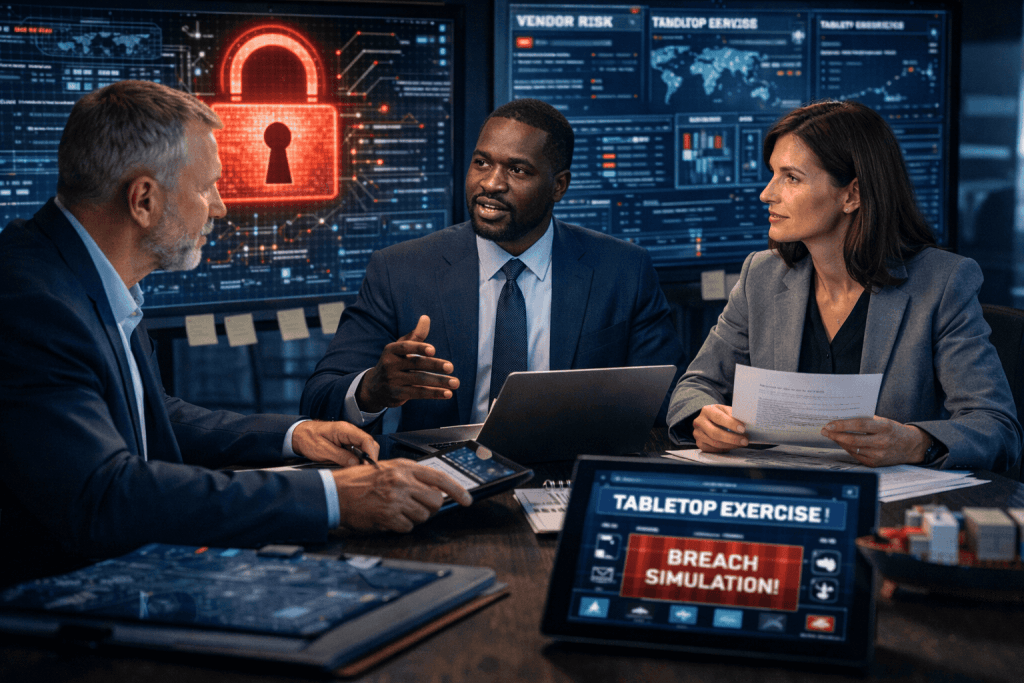
Executive Tabletop Exercises: Breach Simulations That Matter
Most executives have never experienced a security incident until they’re in one. That gap between theory and reality creates dangerous decision paralysis when speed matters most. Tabletop exercises transform abstract policies into muscle memory, exposing gaps in your incident response plans before attackers find them.
Unlike technical drills focused on IT teams, executive tabletop exercises test leadership decision-making, communication protocols, legal obligations, customer notifications, and regulatory responses. They answer critical questions: Who has authority to shut down production systems? How quickly can you assemble your crisis team? What do you tell customers, regulators, and the board?
A Simple, Repeatable Format
Objectives: Test executive decision-making under pressure, validate communication chains, identify gaps in incident response plans, and build leadership confidence for real incidents.
Participants: C-suite executives, IT Director, CISO or security lead, Legal counsel, Communications/PR lead, HR Director (for insider threat scenarios), and key business unit leaders. Keep the group focused—8 to 12 participants maximum.
Duration: 60 to 90 minutes, scheduled quarterly to maintain readiness and adapt to organizational changes.
Agenda:
- 0-10 minutes: Set the scene and ground rules (no phones, treat it as real, decisions have consequences)
- 10-50 minutes: Scenario unfolds through timed “injects” every 8-10 minutes
- 50-75 minutes: Group discussion of decisions made, alternative approaches, and gaps identified
- 75-90 minutes: After-action review with documented improvement actions
Example Injects (Events)
Inject 1 (Monday, 6:15 AM): IT discovers ransomware note on file servers. Approximately 30% of customer data appears encrypted. Attackers demand $2.3M in Bitcoin within 72 hours and threaten to publish stolen data. What do you do in the next 30 minutes?
Inject 2 (Monday, 8:45 AM): Your primary cloud vendor reports their infrastructure was compromised. They believe attackers accessed customer environments, including yours, for the past 11 days. Regulatory notification deadlines start now. How do you respond?
Inject 3 (Monday, 11:30 AM): Employees report suspicious MFA push notifications they didn’t initiate. Security team discovers 47 successful MFA fatigue attacks overnight. Attackers have accessed email accounts of 12 employees, including two executives. What’s your immediate action?
Inject 4 (Tuesday, 2:00 PM): A journalist contacts your PR team saying they received leaked customer data from “a concerned source” and plans to publish tomorrow. The data appears genuine. Board members are calling. What do you communicate and to whom?
Inject 5 (Wednesday, 9:00 AM): State regulators and the FBI request immediate interviews and full forensic access. Your insurance carrier needs detailed incident timeline for coverage determination. Customers are threatening class action litigation. How do you coordinate responses?
Decision Points
Each inject forces executives to make real decisions: technical (isolate systems, preserve forensics), legal (regulatory notifications, law enforcement engagement), communication (internal messaging, customer disclosure, media response), and business (operations continuity, financial impact, liability management).
What Success Looks Like
Successful tabletop exercises reveal gaps, not perfection. Look for clarity in roles and authorities, speed in mobilizing the crisis team, accountability through documented decisions, and effective communication across technical and business stakeholders. The goal isn’t flawless performance—it’s identifying the gaps between your plan and reality before attackers do.
One manufacturing company discovered during their tabletop that nobody could authorize shutting down production systems without the CFO’s approval—and the CFO was unreachable on international flights twice monthly. They revised authority structures immediately. That change prevented a four-hour delay during an actual incident six months later.

Vendor and Supply-Chain Risk: Your Third-Party Blind Spots
Your security is only as strong as your weakest vendor. When a third-party HR platform suffers a breach, your employee data is compromised. When your cloud provider experiences downtime, your business stops. When a software supply chain is poisoned, your systems become attack vectors. Cybersecurity leadership requires treating vendor relationships as critical risk surfaces, not procurement afterthoughts.
According to CISA’s guidance on supply chain risk management, organizations face growing threats from compromised third-party vendors and software dependencies. The challenge: most IT leaders lack visibility into their true vendor attack surface.
A Practical Risk Lens
Tier your vendors by risk and access. Not all vendors deserve equal scrutiny. A SaaS platform with access to customer data requires different security standards than an office supply vendor. Create a three-tier classification based on data access, system connectivity, and business criticality.
Enforce least privilege religiously. Vendors should access only the specific systems and data their service requires—nothing more. One financial institution discovered a marketing analytics vendor had database credentials to production systems “just in case.” That access was never needed and represented catastrophic risk.
Build security requirements into contracts. Legal agreements should mandate security standards, audit rights, breach notification timelines (24-48 hours, not “reasonable time”), and liability provisions. Make security non-negotiable before signatures, not something you hope for afterward.
Monitor vendor access continuously. Quarterly reviews aren’t enough. Implement automated monitoring for vendor account activity, privileged access usage, and data exfiltration patterns. Unusual patterns often indicate compromised vendor credentials.
Maintain vendor offboarding procedures. When vendor relationships end, access must terminate immediately. Orphaned vendor accounts represent low-hanging fruit for attackers. One healthcare system found 23 former vendors still had VPN access three years after contracts ended.
The NIST Cybersecurity Framework emphasizes supply chain risk management as a core component of resilient security programs, particularly as organizations adopt cloud services and complex technology ecosystems.
Vendor Risk Minimum Standards Checklist
Use this checklist to evaluate vendor security posture before onboarding and annually thereafter:
- Security certifications: SOC 2 Type II, ISO 27001, or industry-specific compliance (HITRUST for healthcare, PCI DSS for payment processing)
- Incident response plan: Documented procedures, tested annually, with clear customer notification protocols
- Data encryption: At-rest and in-transit encryption using current standards (AES-256, TLS 1.2+)
- Access controls: Multi-factor authentication required for all vendor personnel accessing customer systems
- Vulnerability management: Regular patching cadence, penetration testing at least annually
- Background checks: Vendor employees with privileged access undergo screening appropriate to data sensitivity
- Subcontractor disclosure: Vendors must identify all subcontractors with access to your data or systems
- Data residency and sovereignty: Clear documentation of where data is stored, processed, and backed up
- Audit rights: Your organization can conduct security audits or review third-party audit reports
- Breach notification: Vendors must notify you within 24 hours of discovering potential compromise
Real-World Scenario: Vendor Risk Goes Wrong
A regional insurance company selected a cloud document management vendor based primarily on cost and features. Security review consisted of checking a “security compliance” box on the procurement form. Eighteen months later, the vendor suffered a breach exposing 340,000 customer documents. The insurance company faced regulatory fines, customer lawsuits, and reputational damage. Investigation revealed the vendor had no SOC 2 certification, used deprecated encryption, and couldn’t produce evidence of security testing. The procurement decision—made without proper IT governance and risk assessment—cost 40 times the savings from choosing the cheaper vendor.

What to Do This Spring: Your Action Plan
Spring’s unique risks—post-holiday patching backlogs, Q1/Q2 system rollouts, remote work pattern shifts—demand focused leadership action. Use this checklist aligned to the three anchors above:
Security Culture Actions:
- Schedule 30-minute security culture conversation with each department head this month
- Review last quarter’s security incidents; identify cultural factors that contributed
- Add security-related question to next all-hands meeting and answer it personally
- Recognize employees who reported security concerns in the past 90 days
Tabletop Exercise Actions:
- Schedule executive tabletop exercise within next 60 days (don’t delegate or postpone)
- Assign ownership for developing scenario and injects (CISO or IT Director)
- Block calendars now—exercises scheduled “when convenient” never happen
- Commit to after-action review with documented improvements within two weeks of exercise
Vendor and Supply-Chain Actions:
- Audit vendor access lists; revoke unnecessary permissions and orphaned accounts
- Identify your five highest-risk vendors (by data access and criticality)
- Request current SOC 2 or ISO 27001 reports from high-risk vendors
- Review vendor contracts for security requirements and notification obligations
- Implement or validate vendor access monitoring for privileged accounts
- Brief procurement team on minimum security standards; make them non-negotiable
The connection between these actions and your organization’s resilience is direct. Leaders who invest time now reduce their crisis response time later, and that speed determines whether incidents become minor inconveniences or career-defining catastrophes.
Organizations that embrace IT leadership best practices recognize that cybersecurity readiness isn’t a technical project—it’s an ongoing leadership commitment that shapes every decision.
Frequently Asked Questions
Q: How is cybersecurity leadership different from traditional IT security management?
A: Cybersecurity leadership focuses on enterprise risk, culture, and executive decision-making rather than just technical controls. While IT security management addresses firewalls, antivirus, and network monitoring, cybersecurity leadership ensures the entire organization—from the board to front-line employees—understands their role in security. It emphasizes psychological safety for reporting incidents, executive preparedness through simulations, and strategic vendor risk management. Traditional IT security asks “Are our systems protected?” Leadership asks “Is our organization resilient when protections fail?”
Q: Why should non-technical executives participate in tabletop exercises?
A: Because technical teams don’t make business decisions during crises—executives do. Tabletop exercises expose gaps in decision authority, communication protocols, legal obligations, and customer impact that technical drills never surface. When ransomware encrypts your systems, someone must decide whether to pay, how to communicate with customers, what to tell regulators, and how to maintain business operations. Those decisions can’t wait for executives to learn during a real crisis. Practice builds the muscle memory and confidence needed for effective crisis leadership.
Q: What’s the single biggest vendor risk mistake IT leaders make?
A: Trusting vendor security claims without verification. Many leaders assume SOC 2 compliance or security certifications mean a vendor is secure. In reality, certifications have scope limitations, point-in-time validity, and varying rigor. The biggest mistake is onboarding vendors based on questionnaires rather than verified evidence. Request actual audit reports, review findings and exceptions, validate that certifications cover the services you’re using, and maintain ongoing monitoring. Trust but verify—especially with vendors accessing sensitive data.
Q: How often should we conduct executive tabletop exercises?
A: Quarterly is ideal for maintaining readiness, but realistic constraints often mean semi-annual exercises. At minimum, conduct executive tabletop exercises whenever significant changes occur: major system implementations, organizational restructuring, new regulatory requirements, or after real security incidents. Annual exercises are insufficient because organizational memory fades, personnel change, and threat landscapes evolve. Cybersecurity leadership requires regular practice, just like fire drills—you don’t practice evacuating the building once and assume everyone remembers three years later.
Q: What if our organization lacks dedicated security staff?
A: Security leadership doesn’t require a large team—it requires leadership commitment. Many successful mid-sized organizations designate a senior IT professional to own security with fractional CISO support or managed security services. Focus on fundamentals: enforce MFA, maintain patching discipline, conduct vendor reviews, and practice incident response. The NIST Cybersecurity Framework and CISA’s free resources provide structured guidance for organizations without dedicated security teams. Start with culture and executive preparedness—these cost leadership time, not budget.
Q: How do we measure the ROI of cybersecurity leadership investments?
A: Measure leading indicators like mean time to detect incidents, employee security reporting rates, vendor security assessment completion rates, and security training engagement. Track outcome metrics including incident frequency, blast radius of security events, recovery time, and cost per incident. Organizations with mature cybersecurity leadership see 50-70% faster incident response, significantly lower breach costs, reduced insurance premiums, and fewer regulatory penalties. The real ROI appears when you avoid the catastrophic incident that costs millions in downtime, remediation, legal fees, and reputational damage. Prevention is invisible until you need it.
Conclusion: Leadership Makes the Difference
The gap between organizations that weather security incidents and those that struggle isn’t technology—it’s leadership. The tools in your security stack matter less than the culture you’ve built, the preparation your executives demonstrate, and the vendor relationships you’ve carefully managed.
Cybersecurity leadership demands that CIOs, IT Directors, and business executives treat security as strategic enterprise risk, not technical overhead. It requires modeling the behaviors you expect, practicing crisis response before crises arrive, and maintaining vigilant oversight of third-party relationships. The organizations that emerge stronger from inevitable security challenges are led by executives who understand this fundamental truth.
This spring, as your teams manage system changes, address patching backlogs, and navigate hybrid work complexities, don’t let cybersecurity become another initiative managed by the IT department alone. Make it a leadership priority. Schedule that executive tabletop exercise. Review your vendor access controls. Model the security behaviors your culture needs.
The next security incident is coming—perhaps this week, perhaps next month. The question that matters: Will your leadership team be ready?
Take action today: Block 90 minutes on your calendar in the next 60 days for an executive tabletop exercise. That single decision might be the most valuable security investment you make this year.
For more insights on building resilient IT organizations, explore our resources on IT leadership resilience, managing IT team burnout, and strategic technology planning.

Chris "The Beast" Hall – Director of Technology | Leadership Scholar | Retired Professional Fighter | Author
Chris "The Beast" Hall is a seasoned technology executive, accomplished author, and former professional fighter whose career reflects a rare blend of intellectual rigor, leadership, and physical discipline. In 1995, he competed for the heavyweight championship of the world, capping a distinguished fighting career that led to his induction into the Martial Art Hall of Fame in 2009.
Christopher brings the same focus and tenacity to the world of technology. As Director of Technology, he leads a team of experienced technical professionals delivering high-performance, high-visibility projects. His deep expertise in database systems and infrastructure has earned him multiple industry certifications, including CLSSBB, ITIL v3, MCDBA, MCSD, and MCITP. He is also a published author on SQL Server performance and monitoring, with his book Database Environments in Crisis serving as a resource for IT professionals navigating critical system challenges.
His academic background underscores his commitment to leadership and lifelong learning. Christopher holds a bachelor’s degree in Leadership from Northern Kentucky University, a master’s degree in Leadership from Western Kentucky University, and is currently pursuing a doctorate in Leadership from the University of Kentucky.
Outside of his professional and academic pursuits, Christopher is an active competitive powerlifter and holds three state records. His diverse experiences make him a powerful advocate for resilience, performance, and results-driven leadership in every field he enters.



0 Comments