

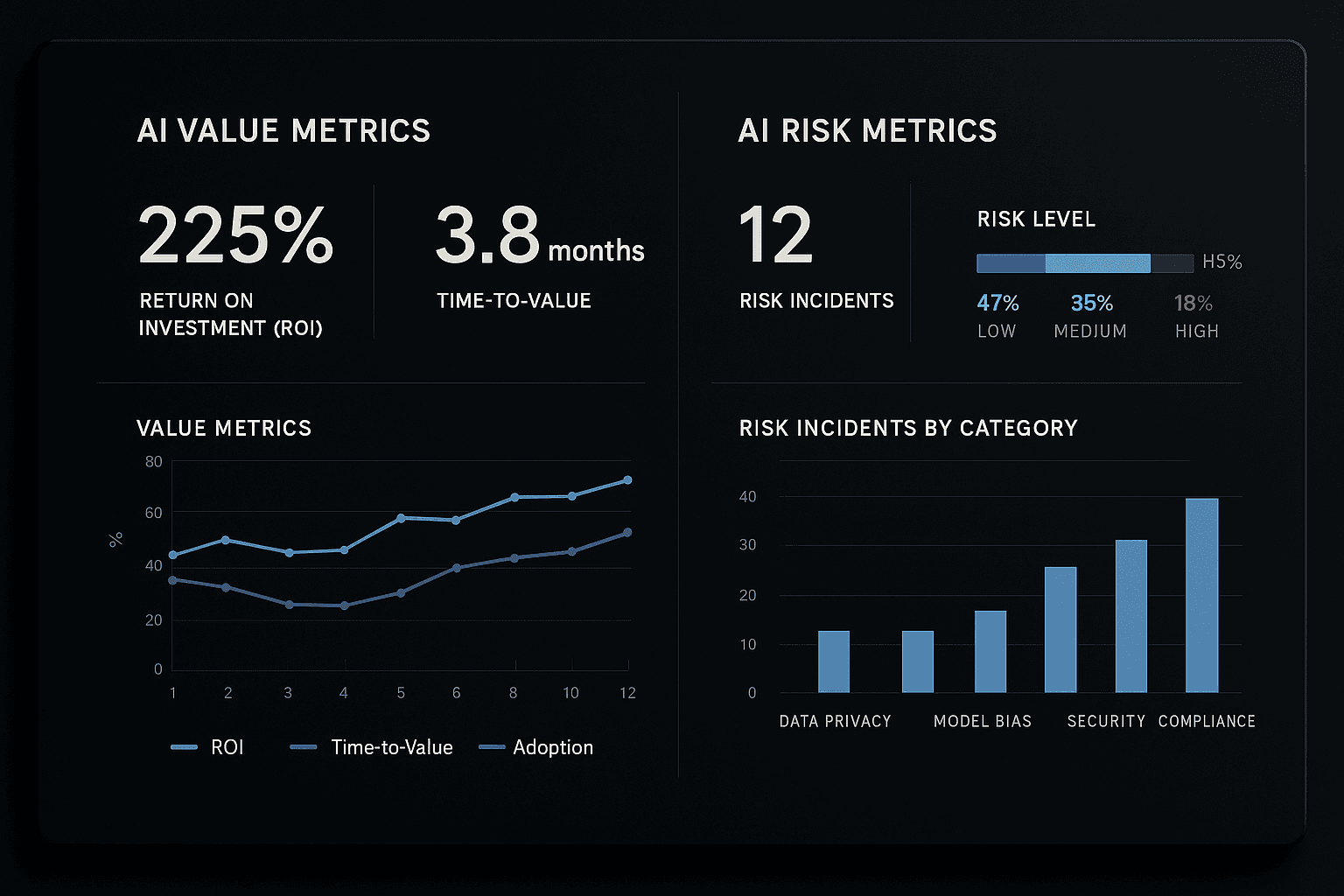
How to Harness the Power of AI as a Tool for Leadership in the Field of Information Technology
Artificial intelligence is no longer a futuristic add-on for IT leaders—it’s a foundational capability. CIOs, CTOs, IT directors, and engineering leaders who use AI for Leadership are finding themselves able to make faster decisions, clarify strategies, coach teams more effectively, and accelerate innovation. Those who don’t are struggling to keep pace with competitors who now augment nearly every leadership function with intelligent tools.
In this article, we’ll explore how modern IT leaders can practically and responsibly harness AI as a leadership multiplier—without hype, without fear, and without losing the human core of leadership. For additional leadership insights and resources, visit IT Leadership Hub.
Why AI for Leadership Matters (A Strategic Lens)
AI fundamentally reshapes the leadership landscape in IT—not just the operational one.
AI transforms decision-making
Leaders no longer need to rely solely on instinct or manually assembled dashboards. AI models can surface patterns across vast datasets: customer behavior, system logs, project velocity, or cybersecurity anomalies. Leaders equipped with AI-enhanced insights can make faster, sharper, and more future-oriented decisions.
AI elevates risk management
Instead of reacting when something breaks, IT leaders can use AI to:
- Predict outages based on historical patterns
- Analyze security vulnerabilities in real time
- Model the downstream effects of architectural changes
This shifts leadership from “firefighting” to proactive stewardship.
AI accelerates innovation and time-to-value
While using AI for Leadership, keep in mind AI dramatically reduces the time it takes to generate ideas, run experiments, and evaluate new opportunities. When used effectively, AI enables leaders to push more innovation cycles in less time—with clearer alignment to business outcomes.
Key Ways IT Leaders Can Harness AI as a Tool
1. AI for Better Strategic Decision-Making
While using Matters, can act like a strategic co-pilot, helping leaders weigh options faster.
Examples:
- Scenario modeling: Leaders can ask AI, “Simulate the impact of increasing cloud spend by 20% across 12 months,” and instantly review multiple outcomes.
- Data synthesis: AI can summarize logs, surveys, and performance metrics into a single, accessible narrative.
The leader’s role:
Shift from gathering data to questioning data. The value comes from asking smarter questions, interpreting insights, and setting direction—not from the AI output alone.
2. AI for Communication and Stakeholder Alignment
Misalignment kills IT projects. Using AI for Leadership helps reduce that risk.
Examples:
- Drafting strategy documents or board updates.
- Summarizing customer complaints or executive feedback.
- Translating technical content into business language.
The leader’s role:
Use AI for Leadership to remove communication friction—but maintain ownership of message accuracy and tone.
3. AI for Leadership with Talent Development and Coaching
AI can support leaders in coaching individuals and teams more effectively.
Examples:
- Personalized learning paths for engineers using skills data.
- Summaries of one-on-one notes that highlight themes, strengths, and gaps.
- Drafting development plans based on observed behaviors and performance metrics.
The leader’s role:
Turn AI insights into real human conversations—praise, correction, support, accountability.
4. AI for Operational Visibility and Incident Management
IT operations generate overwhelming amounts of data. AI turns noise into clarity.
Examples:
- Real-time incident summaries across distributed systems.
- Root-cause pattern detection.
- Predictive alerts on performance degradation.
The leader’s role:
Use AI for Leadership to speed understanding, not to replace engineering judgment. Decisions, ownership, and accountability remain human.
5. AI for Innovation and Experimentation
AI supercharges the experimentation cycle.
Examples:
- Rapid prototyping of applications.
- Instant market or competitor analysis.
- Brainstorming sessions augmented with generative ideation.
The leader’s role:
Set boundaries, define innovation themes, and ensure experimentation aligns with business strategy.
The L.E.A.D. with AI Framework: A Simple Leader’s Guide
This framework offers a structured way for IT leaders to integrate AI into leadership practices.
1. Listen – Gather and Understand Signals
Use AI to synthesize signals from logs, customer feedback, surveys, and metrics.
Tip: Review AI-generated summaries weekly to spot patterns earlier.
2. Explore – Model Options and Scenarios
Use AI tools to simulate architectural changes, budget plans, and resource allocations.
Watch-out: Avoid over-trusting single-model outputs; always compare multiple scenarios.
3. Align – Communicate Strategy with Clarity
Use AI to draft memos, decks, and stakeholder updates.
Tip: Let AI draft, but ensure the leader edits for tone, accuracy, and alignment to values.
4. Decide – Make Human-Centered Decisions
AI provides insights, not accountability.
Tip: Encourage your team to use AI to surface alternatives before major decisions.
5. Develop – Grow People and Culture
Use AI to highlight skill gaps, recommend training, or analyze team sentiment.
Watch-out: Avoid using AI to evaluate performance autonomously—it should inform, not decide.
Guardrails for Ethical, Secure, and Responsible AI Use
AI for Leadership must be grounded in responsibility. Consider implementing these guardrails:
1. Protect data privacy and security
Establish clear policies for what data can be used with AI tools. Sensitive data (e.g., HR files, customer PII) requires strict governance.
2. Mitigate bias and ensure fairness
Regularly review outputs for patterns of bias. Encourage diverse review teams.
3. Avoid over-reliance
Leaders must interpret—not blindly trust—AI outputs. AI accelerates thinking; it does not replace critical judgment.
4. Establish human-in-the-loop workflows
AI may draft, summarize, or analyze, but humans make final decisions.
(See an excellent overview from external experts at Harvard Business Review.)
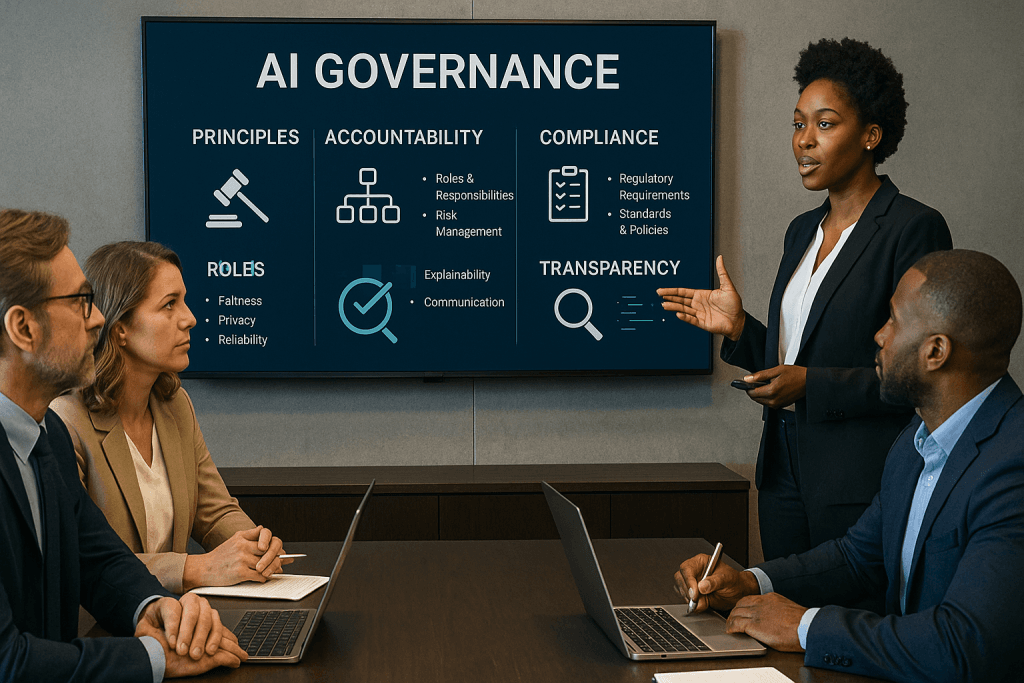
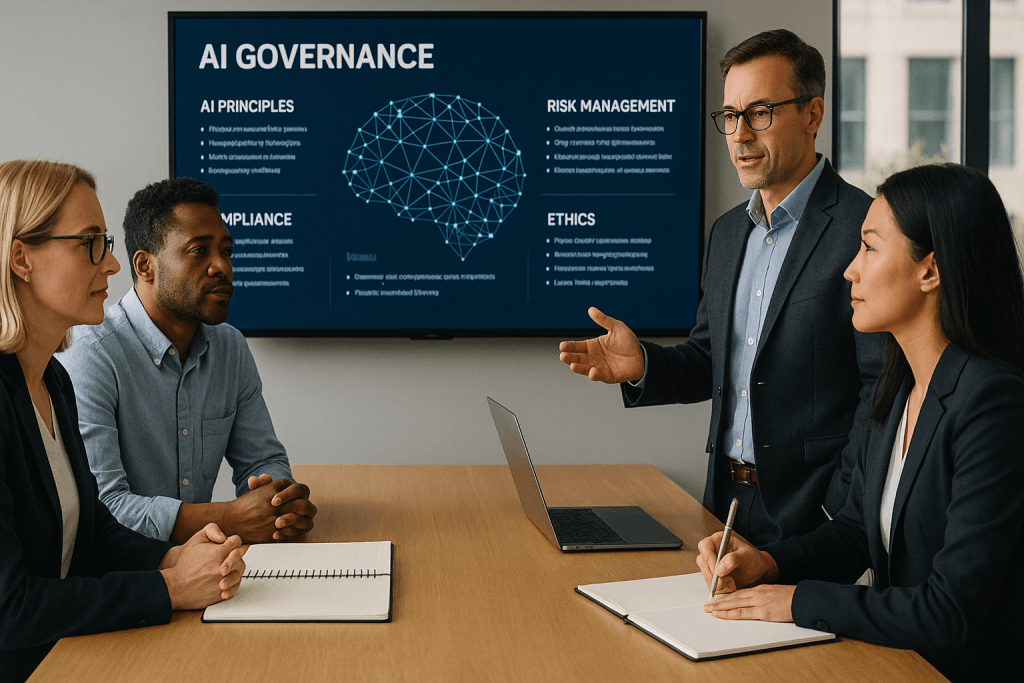
5. Implement an AI governance board
Include IT, security, legal, HR, and business stakeholders.
This board sets policy, reviews risks, and approves new AI capabilities.
Getting Started: The First 5 Moves for an IT Leader
Here are five practical steps to start harnessing AI for Leadership immediately:
- Identify 2–3 leadership tasks to augment with AI for Leadership
Examples: meeting preparation, strategy drafts, communications, or scenario modeling. - Pilot AI co-pilot tools with your leadership team
Give each director or manager a use case to test and share insights weekly. - Create lightweight AI usage guidelines
Start small: what tools are approved, what data is off-limits, and what review steps are required? - Host monthly “AI Learn & Share” sessions
Encourage leaders and engineers to present quick demos of what’s working. - Measure impact and adjust
Track time saved, decision speed, and stakeholder clarity. Iterate continuously.
Conclusion
AI for Leadership: AI is not replacing leadership—AI is multiplying leadership. When used strategically, ethically, and creatively, AI becomes a force amplifier that helps IT leaders make better decisions, communicate more clearly, innovate faster, and develop stronger teams.
Leaders who embrace AI with humility, curiosity, and conviction will shape the future of their organizations—and the future of the IT profession.
To deepen your leadership development and continue exploring the frontier of AI for Leadership, visit IT Leadership Hub for tools, insights, and guidance tailored to modern IT executives.
The future belongs to leaders who choose to harness AI—not fear it.

Chris "The Beast" Hall – Director of Technology | Leadership Scholar | Retired Professional Fighter | Author
Chris "The Beast" Hall is a seasoned technology executive, accomplished author, and former professional fighter whose career reflects a rare blend of intellectual rigor, leadership, and physical discipline. In 1995, he competed for the heavyweight championship of the world, capping a distinguished fighting career that led to his induction into the Martial Art Hall of Fame in 2009.
Christopher brings the same focus and tenacity to the world of technology. As Director of Technology, he leads a team of experienced technical professionals delivering high-performance, high-visibility projects. His deep expertise in database systems and infrastructure has earned him multiple industry certifications, including CLSSBB, ITIL v3, MCDBA, MCSD, and MCITP. He is also a published author on SQL Server performance and monitoring, with his book Database Environments in Crisis serving as a resource for IT professionals navigating critical system challenges.
His academic background underscores his commitment to leadership and lifelong learning. Christopher holds a bachelor’s degree in Leadership from Northern Kentucky University, a master’s degree in Leadership from Western Kentucky University, and is currently pursuing a doctorate in Leadership from the University of Kentucky.
Outside of his professional and academic pursuits, Christopher is an active competitive powerlifter and holds three state records. His diverse experiences make him a powerful advocate for resilience, performance, and results-driven leadership in every field he enters.



0 Comments